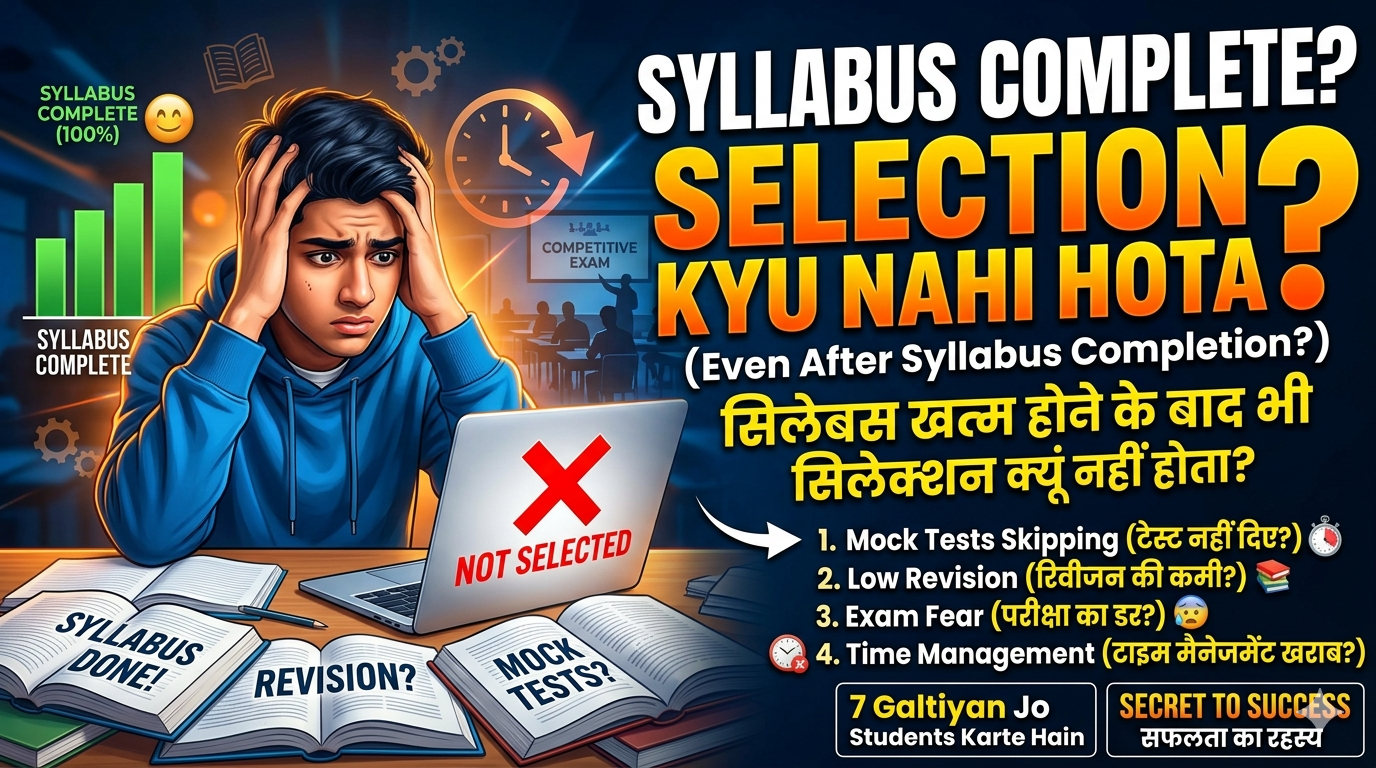
Aaj ke time me bahut students ka yeh common problem hai ki unka poora syllabus complete ho jata hai, lekin phir bhi exam me selection nahi hota. Yeh situation frustrating hoti hai, kyunki student ko lagta hai ki usne sab kuch padh liya hai—phir bhi result kyu nahi aa raha?
Reality yeh hai ki syllabus complete karna sirf preparation ka ek part hai, poori preparation nahi. Selection depend karta hai aapki practice, revision, accuracy, speed aur exam strategy par. Bahut students months tak padhai karte hain, lekin jab exam aata hai to unki performance expected level par nahi hoti.
Is article me aapko clear samajh milega ki syllabus complete hone ke baad bhi selection kyu nahi hota, kaun-si mistakes students karte hain, aur kaise aap apni preparation ko result-oriented bana sakte hain.
Agar aapne abhi preparation start ki hai, to pehle yeh detailed guide zarur padhein:
Govt Job Preparation Kaise Start Kare 2026
Syllabus Complete Hone ke Baad Bhi Selection Kyu Nahi Hota?
Syllabus complete karna ek achievement hai, lekin agar uske baad bhi aapka score improve nahi ho raha, to iska matlab hai ki preparation me kahin na kahin gap hai. Yeh gap mostly application, revision aur testing phase me hota hai.
Syllabus Complete vs Exam Ready (Real Difference)
| Factor | Syllabus Complete | Exam Ready |
| Focus | Topics finish | Questions solve |
| Approach | Theory | Practice + Analysis |
| Revision | Limited | Regular |
| Mock Test | Optional | Mandatory |
| Result | Uncertain | Predictable |
1. Practice Ki Kami – Sabse Badi Reality
Bahut students ka focus hota hai ki wo jaldi se syllabus complete kar lein. Is process me wo theory to padh lete hain, lekin usko questions me apply karna skip kar dete hain. Exam me jo questions aate hain, wo direct book se nahi hote—unme thoda twist hota hai, jise solve karne ke liye practice zaruri hoti hai.
Jab aap practice nahi karte, to aapka dimaag sirf information store karta hai, lekin problem-solving skill develop nahi hoti. Isi wajah se aapko lagta hai ki “sab aata hai”, lekin paper me question solve nahi hota.
Iska solution simple hai: har topic ke baad enough questions solve karo, alag-alag level ke questions karo, aur previous year questions ko ignore mat karo. Practice hi wo stage hai jahan real preparation hoti hai.
2. Revision System Weak Hona – Bhoolne Ka Cycle
Human brain naturally cheezein bhoolta hai. Agar aap kisi topic ko ek baar padhkar chhod dete ho, to kuch din baad wo automatically memory se fade ho jata hai. Isi wajah se bahut students bolte hain ki “yeh maine padha tha, par yaad nahi aa raha”.
Syllabus complete hone ke baad agar revision system strong nahi hai, to aapka pura effort dheere-dheere waste ho jata hai. Exam ke time par confusion hota hai, aur concepts clear hone ke bawajood recall nahi hota.
Is problem ka solution hai regular aur planned revision. Aapko ek cycle follow karna chahiye jisme aap short intervals par topics ko repeat karte raho. Short notes, formula sheets aur quick revision techniques yahan bahut help karti hain. Revision hi knowledge ko long-term memory me convert karta hai.
3. Mock Test Ko Importance Nahi Dena
Bahut students syllabus complete hone tak mock test ko ignore karte rehte hain. Unhe lagta hai ki jab sab complete ho jayega tab mock denge. Yeh approach galat hai, kyunki mock test hi wo tool hai jo aapko real exam ka experience deta hai.
Jab aap mock test nahi dete, to aapko yeh pata hi nahi chalta ki aapka actual level kya hai. Time management, pressure handling, question selection—yeh sab skills sirf mock test se develop hoti hain.
Agar aap regularly mock test nahi dete, to exam hall me jaakar aapko sab kuch naya lagega. Isliye mock test ko optional nahi, preparation ka compulsory part samjho.
4. Mock Analysis Nahi Karna – Improvement Block
Mock test dena important hai, lekin usse bhi zyada important hai uska analysis. Bahut students sirf test dete hain, marks dekhte hain aur next test par move kar jaate hain. Yeh sabse badi galti hoti hai.
Agar aap apni mistakes ko analyze nahi karte, to aap unhe dobara repeat karte ho. Aapka score wahi ka wahi reh jata hai, chahe aap kitne bhi mock test de lo.
Analysis ka matlab hai samajhna ki galti kyu hui—concept clear nahi tha, question galat read kiya, ya time pressure tha. Jab aap yeh identify kar lete ho, tabhi aap improvement kar sakte ho.
5. Accuracy Low Hona – Negative Marking Ka Impact
Bahut students zyada questions attempt karne par focus karte hain, lekin accuracy par dhyan nahi dete. Iska result yeh hota hai ki unke marks negative marking ki wajah se kam ho jate hain.
Exam me sirf attempt karna important nahi hai, sahi attempt karna important hai. Agar aapka accuracy level low hai, to aap cutoff clear nahi kar paoge, chahe aapne syllabus complete hi kyu na kiya ho.
Is problem ka solution hai controlled attempt aur focused practice. Easy aur sure questions ko pehle solve karo, doubtful questions ko baad me attempt karo. Dheere-dheere accuracy improve hogi.
6. Speed Aur Time Management Ki Problem
Kai students ke saath yeh hota hai ki unhe answers aate hain, lekin wo paper complete nahi kar paate. Iska reason hota hai speed aur time management ka weak hona.
Agar aapne practice hamesha bina timer ke ki hai, to exam me time pressure aapko disturb karega. Aap slow ho jaoge, ya phir panic me galtiyan karoge.
Is problem ka solution hai timed practice. Aapko daily basis par timer ke saath questions solve karne chahiye. Section-wise timing fix karni chahiye aur gradually apni speed improve karni chahiye.
7. Exam-Oriented Study Nahi Karna
Bahut students ka focus hota hai ki wo pura syllabus complete karein, lekin wo yeh nahi dekhte ki exam me actually kya important hai. Is wajah se wo low-weight topics par zyada time spend kar dete hain aur important topics ko lightly le lete hain.
Exam ek pattern follow karta hai, aur agar aap us pattern ko samajh lete ho, to aap apni preparation ko optimize kar sakte ho. Previous year questions isme sabse bada role play karte hain.
Agar aap exam-oriented study nahi karte, to aapki preparation directionless ho jati hai, aur result weak aata hai.
8. Multiple Sources Follow Karna
Aaj ke time me resources ki kami nahi hai—YouTube, books, notes, PDFs sab available hain. Problem tab hoti hai jab student ek hi topic ke liye multiple sources follow karne lagta hai.
Isse confusion create hota hai aur concept kabhi clear nahi hota. Har teacher ka alag method hota hai, aur jab aap sabko mix karte ho, to clarity khatam ho jati hai.
Best approach yeh hai ki har subject ke liye ek reliable source choose karo aur usi ko baar-baar revise karo. Depth tab aati hai jab aap same material ko multiple times revise karte ho.
9. Weak Subjects Ko Ignore Karna
Students naturally un subjects par zyada time dete hain jisme wo comfortable hote hain. Weak subjects ko wo avoid karte rehte hain, kyunki unme effort zyada lagta hai.
Lekin exam me selection overall score se hota hai, kisi ek subject se nahi. Agar aapka ek subject bahut weak hai, to wo aapke total score ko neeche le aayega.
Isliye weak subjects ko ignore karna sabse badi mistake hai. Unhe gradually improve karna chahiye, basic se start karke step-by-step strong banana chahiye.
10. Consistency Break Hona – Preparation Ka Flow Tutna
Syllabus complete hone ke baad bahut students relax ho jate hain. Unhe lagta hai ki ab sab ho gaya hai, bas thoda revision karna hai. Isi mindset ki wajah se unki consistency break ho jati hai.
Preparation me consistency sabse important factor hai. Agar aap daily effort nahi lagate, to aapka flow break ho jata hai aur performance girne lagti hai.
Iska solution hai daily routine maintain karna. Chahe kam padhai karo, lekin regular padhai karo. Consistency hi long-term success ka base hai.
Syllabus Completion vs Real Preparation (Clear Difference)
Bahut students yeh maan lete hain ki “syllabus complete ho gaya = main exam ke liye ready hoon”, lekin yahi sabse bada misunderstanding hota hai. Reality me syllabus completion sirf ek starting line hai, jabki real preparation ek performance system hai jo aapko selection tak le jata hai.
Chaliye ab har important point ko detail me samajhte hain—sirf difference nahi, balki uske peeche ki real logic + hidden insight bhi
Basic Difference Samajh Lo
| Factor | Syllabus Completion | Real Preparation |
| Nature | Passive Learning | Active Learning |
| Goal | Topics finish karna | Exam crack karna |
| Outcome | “Mujhe aata hai” feeling | Real score improvement |
1. Focus Ka Difference – “Khatam Karna” vs “Clear Karna”
Syllabus completion me student ka main focus hota hai ki wo jitni jaldi ho sake saare chapters finish kar le. Uska mindset hota hai: “Bas yeh chapter complete ho jaye”. Is process me wo speed par zyada dhyan deta hai, depth par nahi.
Real preparation me focus completely shift ho jata hai. Yahan goal hota hai ki har topic itna clear ho ki usse related koi bhi question aap confidently solve kar pao. Yahan “kitna padha” important nahi hota, balki “kitna samjha aur apply kiya” important hota hai. Topper kabhi “chapter complete” nahi bolte, wo bolte hain “topic clear ho gaya”.
2. Approach Ka Difference – Theory vs Application
Syllabus completion ka approach hota hai theory-based. Student lecture dekhta hai, notes banata hai, aur samajhta hai ki usne topic cover kar liya. Lekin yeh learning surface level par hoti hai.
Real preparation me approach completely application-based hota hai. Yahan student har concept ko questions ke through test karta hai. Wo dekhna chahta hai ki jo usne padha hai, wo real exam situation me kaam kar raha hai ya nahi. “Reading creates familiarity, but practice creates mastery.”
3. Revision Ka Difference – Optional vs Systematic
Syllabus completion phase me revision ko aksar ignore kar diya jata hai ya kabhi-kabhi kar liya jata hai. Student sochta hai ki “abhi naya padh lete hain, revision baad me kar lenge”.
Real preparation me revision ek fixed system hota hai. Har topic ko multiple times revise kiya jata hai taaki wo long-term memory me store ho jaye. Yahan revision bina gap ke planned hota hai. Brain ek baar padhne se nahi, baar-baar recall karne se strong hota hai.
4. Mock Test Ka Role – Last Step vs Core Process
Syllabus completion wale students mock test ko end me rakhte hain. Unka mindset hota hai: “Pehle sab complete kar lete hain, phir test denge”. Is wajah se unhe real performance ka idea late milta hai.
Real preparation me mock test starting se hi include hota hai. Student apni preparation ko continuously test karta rehta hai. Isse usko pata chalta rehta hai ki wo sahi direction me ja raha hai ya nahi. Mock test ek measurement tool hai—jo measure nahi hota, wo improve nahi hota.
5. Confidence Ka Difference – Feeling vs Reality
Syllabus complete hone ke baad student ko lagta hai ki wo ready hai. Yeh confidence mostly feeling par based hota hai, kyunki usne sab kuch padh liya hota hai.
Real preparation me confidence actual performance se aata hai. Jab aap multiple mock tests me consistent score laate ho, tab jo confidence aata hai wo real hota hai. “Fake confidence padhai se aata hai, real confidence performance se aata hai.”
“Syllabus complete karna ek achievement hai, lekin usko exam me result me convert karna hi real preparation hai.”
Agar aap confuse ho ki smart study kare ya hard study, to yeh article aapki clarity badha dega:
Smart Study vs Hard Study: Kaun Sa Better Hai
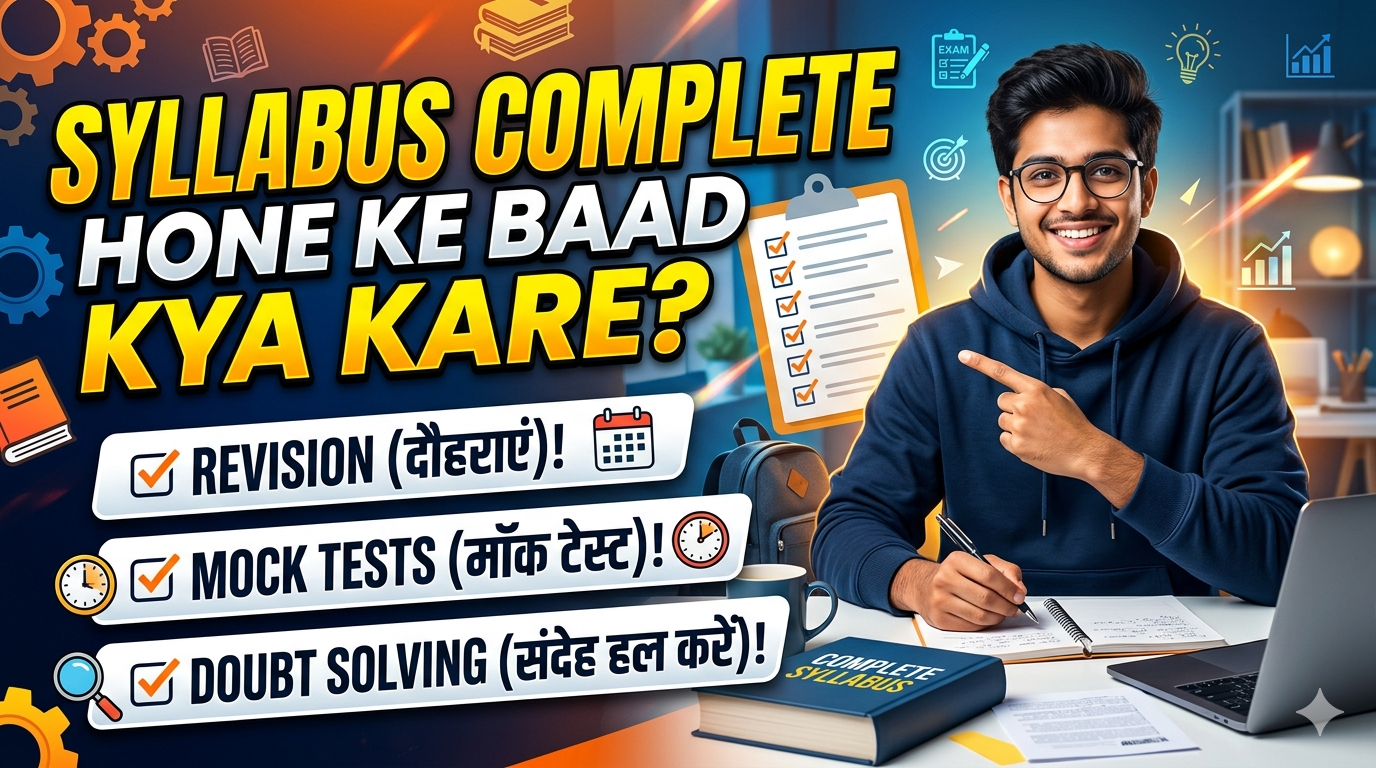
Syllabus Complete Hone Ke Baad Kya Kare? (Right Strategy)
Bahut students yahan galti kar dete hain—syllabus complete hote hi unka direction khatam ho jata hai. Kuch log relax ho jaate hain, kuch random padhai start kar dete hain. Yahin se preparation weak padti hai.
Reality yeh hai ki syllabus completion ke baad hi real preparation start hoti hai. Agar aapne is phase ko sahi handle kar liya, to selection ke chances 2x–3x badh jate hain. Chaliye ab ek clear, practical aur topper-level strategy samajhte hain
1. Practice Mode ON (Application Build Karo)
Ab aapko maximum time questions solve karne me lagana hai, kyunki exam me wahi kaam aayega.
- Daily 100–150 questions solve karo
- Topic-wise + mixed practice dono karo
- PYQ (Previous Year Questions) ko priority do
“Practice bina pressure ke nahi, timer ke saath karo—tabhi real improvement hoga”
2. Mock Test + Deep Analysis System (Game Changer)
Yeh phase ka sabse important part hai.
- Week me 2–3 full mock test
- Daily 1 sectional test (optional but powerful)
Sabse important: Analysis
- Galtiyon ko likho
- Weak topics identify karo
- Time management check karo
“Mock test aapka level nahi batata, analysis aapka level improve karta hai”
3. Strong Revision Cycle (Memory Fix Karo)
Agar revision strong nahi hoga, to aapki preparation dheere-dheere weak hoti jayegi.
System follow karo:
- Weekly full revision
- Daily short revision (1–2 hours)
- Formula/facts repeat karo
Topper naya kam padhte hain, lekin purana baar-baar revise karte hain
4. Weak Areas Par Attack Karo (Score Booster)
Ab aapko apni weaknesses identify karke un par kaam karna hai.
- Har mock ke baad weak topic note karo
- Us topic ko same week me cover karo
- Extra practice do
“Selection strong subject se nahi, weak subject improve karne se hota hai”
5. Accuracy + Speed Optimize Karo
Is phase me aapko sirf padhna nahi, performance optimize karni hai
- Accuracy 85–90% target karo
- Guess work kam karo
- Time-bound practice karo
“Topper zyada attempt nahi karte, sahi attempt karte hain”
Final Strategy Snapshot
| Activity | Daily Focus |
| Practice | 40–50% |
| Revision | 20–30% |
| Mock + Analysis | 20–30% |
“Syllabus complete karna preparation ka end nahi, selection journey ka real start hai.”
“Agar aapka score stuck hai, to honestly yeh aapki galti nahi hai—strategy issue hai”
Real Performance Difference (Reality Check)
Yahan sabse bada myth toot ta hai—“zyada padhai = better result”. Ground reality me result ka direct relation hours se nahi, strategy + execution se hota hai. Isi liye kuch students kam time padhkar bhi high score le aate hain, aur kuch zyada padhkar bhi average reh jaate hain. Chaliye real difference ko clearly samajhte hain
3 Month Performance Comparison
| Study Pattern | Avg Mock Score (Start) | Avg Mock Score (After 3 Months) | Improvement |
| Sirf Syllabus Complete | 40–45% | 45–50% | Slow |
| Practice + Mock + Revision | 40–45% | 70–80% | Fast |
1. Sirf Syllabus Complete Karne Wale Students Ka Pattern
Aise students genuinely mehnat karte hain, lekin unki preparation incomplete structure par based hoti hai.
Unka routine kuch aisa hota hai:
- Daily padhai (theory + notes)
- Kabhi-kabhi practice
- Mock test irregular
- Revision occasional
Shuru me unhe lagta hai ki wo achha kar rahe hain, kyunki unka syllabus complete ho raha hota hai. Lekin jab wo mock test dete hain, to score expected level par nahi aata.
Actual Problem
- Concept samajh hai, lekin application weak
- Questions solve karne ki habit nahi
- Exam pattern ki understanding kam
Result Pattern
- Score 40–50% ke beech stuck rehta hai
- Improvement slow hoti hai
- Confidence fluctuate karta hai
“Knowledge hai, lekin exam me use karna nahi aata”
2. Real Preparation Follow Karne Wale Students Ka Pattern
Yeh students shayad shuru me average hote hain, lekin unki strategy strong hoti hai.
Unka routine kuch aisa hota hai:
- Daily practice (questions solving)
- Regular mock test
- Har test ka deep analysis
- Strong revision system
Yeh students apni preparation ko continuously test karte rehte hain, isliye unhe har week apni improvement dikhti hai.
Actual Strength
- Concept + application dono strong
- Exam pattern clear
- Mistakes control me
Result Pattern
- Score gradually improve hota hai
- 40% → 55% → 65% → 75%+
- Confidence stable hota hai
“Ye log padhai kam nahi karte, sahi jagah par karte hain”
“Exam me result unka aata hai jo apni preparation ko measure, analyze aur improve karte hain—sirf padhne wale nahi.”
Real Experience Insight (Ground Reality)
“Maine personally 4–5 months tak sirf syllabus complete karne par focus kiya. Har subject ke notes bana liye the, lekin jab mock test diya to score 45% ke aas-paas hi tha.
Phir maine strategy change ki—daily PYQ solve kiye, mock test start kiya aur har test ka analysis kiya. 2 months ke andar mera score 70%+ tak improve ho gaya.
Tab samajh aaya ki syllabus complete karna enough nahi hai, real game practice aur analysis ka hai.”
Conclusion
Syllabus complete karna ek important milestone hai, lekin selection ka real game uske baad start hota hai. Bahut students yahin par ruk jaate hain—unhe lagta hai ki ab bas thoda revision karke exam clear ho jayega. Lekin reality me selection unhi ka hota hai jo apni preparation ko exam-oriented system me convert karte hain.
Agar aap sirf padhte rahoge to knowledge milega, lekin agar aap practice, revision, mock test aur analysis add kar doge, tab result milega. Yahi wo difference hai jo average aur topper ke beech gap create karta hai.
Agar aap next 2–3 months tak disciplined system follow karte ho, to aapka score aur confidence dono clearly improve honge
Final Formula:
Syllabus + Practice + Revision + Mock Analysis + Consistency = Selection
About the Author
Yeh article ek aise student ke experience aur research par based hai jo pichhle kai saalon se competitive exams ki preparation strategy aur student mistakes ko deeply analyze kar raha hai. Yahan di gayi strategies practical aur real exam experience par based hain.
FAQ (Frequently Asked Questions)
Kya sirf syllabus complete karne se exam clear ho sakta hai?
Nahi. Syllabus complete karna zaruri hai, lekin sufficient nahi hai. Exam clear karne ke liye practice, revision aur mock test equally important hote hain.
Syllabus complete hone ke baad sabse pehla step kya hona chahiye?
Sabse pehla step hona chahiye practice mode start karna—daily questions solve karo aur PYQ par focus badhao.
Score improve nahi ho raha, kya kare?
Agar score improve nahi ho raha, to problem padhai me nahi, strategy me hai. Apni mistakes analyze karo aur weak areas par kaam karo.
Weak subject ko kaise improve kare?
Basic se start karo, daily thoda time do, aur us subject ke easy questions se practice start karo.

मैं रोहित वर्मा ( हिंदी कंटेंट राइटर स्पेशलिस्ट ) जिला पटना, बिहार का रहने वाला हूँ और आप सभी को बता दूँ की मैं मगध यूनिवर्सिटी से B.SC किया हूँ और 4 साल लेखन कार्य करता आ रहा हूँ। मैं सरकारी जॉब्स , एग्जाम प्रिपरेशन गाइड और करियर गाइड से सम्बंधित लेख लिखने का कार्य करते आ रहा हूँ ।